

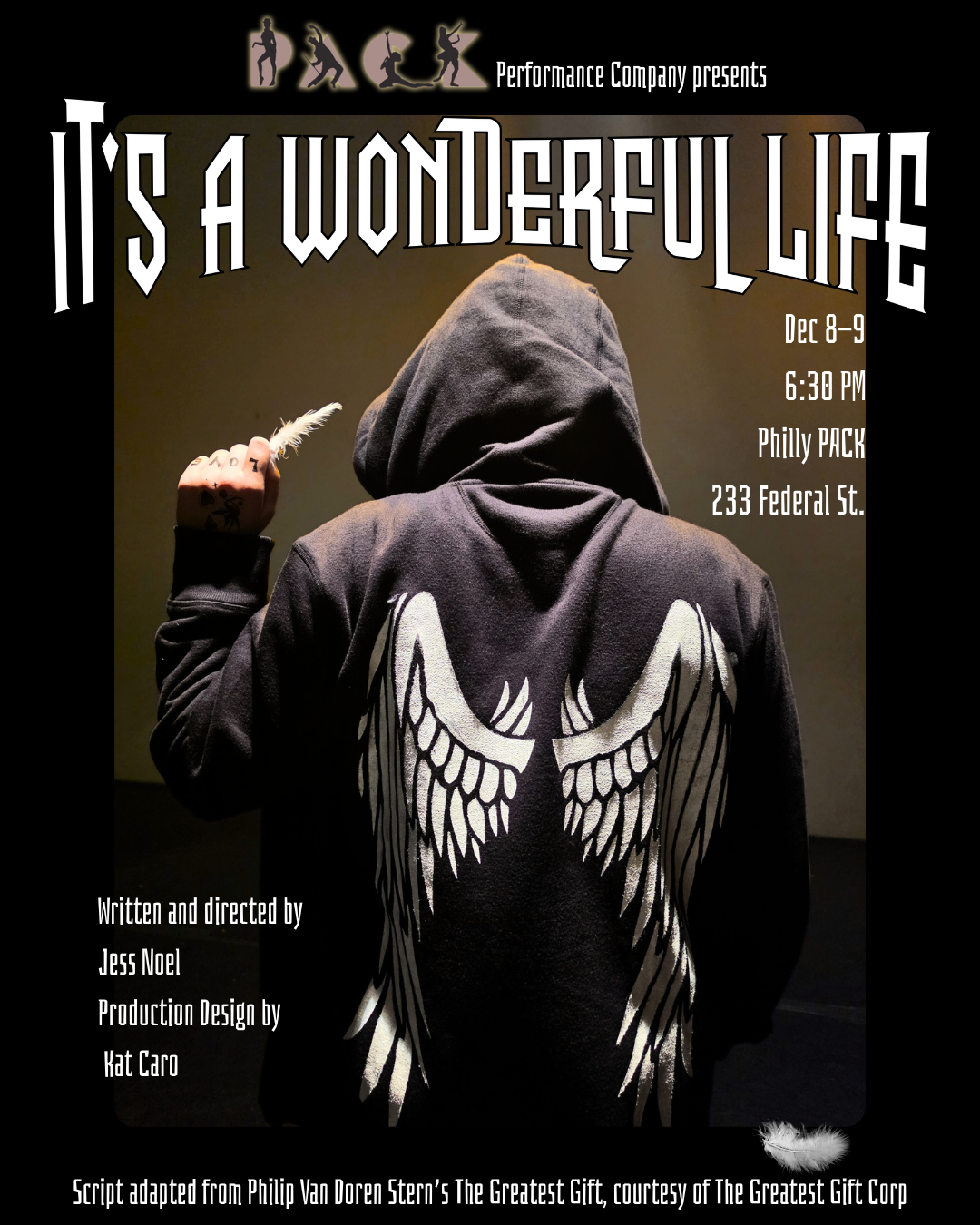
It’s A Wonderful Life, adapted by Jessica Noel, is set in a tattoo shop called BAILEY INK. Philly PACK, 2026.
To Mic, or Not To Mic? That is the question!
Vocal amplification is important. If the audience can’t hear the story, the project’s message falls flat and we miss the whole point of the piece. But are we too hasty with the band-aid fix of slapping body mics on students? I want to counter with a push-back: we should prioritize proper vocal projection technique rather than relying on microphones. A properly-trained actor who can fill a space with their voice without shouting or straining is a director’s dream. As I always say, “My favorite type of student is a LOUD student.”
In the Ancient Greek amphitheaters, during the olden days of Sophocles and Euripides, actors went through rigorous technical training to learn how to fill a five-thousand-seat outdoor space with just their voice. Yes, they engineered masks with built-in megaphones. They also relied heavily on their physical movement to accompany their voice, providing context clues in case a gust of wind blew through and caused an auditory challenge. For the most part, however, the Greek actors trained by strengthening their voices through exercises that built up their stomach muscles and vocal chords.
In my classroom, this is a two-part lesson: 1) I remind students to fill their stomach with air and push through their abs to fill the space with their voice. This is called From the Diaphragm. Actors who engage their stomach muscles for vocal projection should not only feel the activated abdominals throughout the show, but should actually have sore abs afterwards. 2) The second part of my curriculum is annunciation, or Chewing on the Words. I encourage students to analyze the text and song lyrics for consonants that can be punctuated or vowels that can be lengthened to ensure audiences know exactly what is being said.
An example of “chewing” is found in my recent rehearsal classroom: in PACK’s adaptation of It’s A Wonderful Life, George Bailey owns a tattoo shop called BAILEY INK. We’ve had to really train the tongue to punctuate Bailey. Ink. Adding punctuation between the two words is essential because if the words run together into one, the name of the shop becomes “Balynk.”
Relying on microphones is a surefire way to lose storytelling momentum should something go wrong, and they often do go wrong, especially in educational productions. Batteries die, students walk backstage with a microphone still turned on and suddenly the audience hears private conversations from offstage, or students move too close to the amps, causing aggressive feedback. Without professional sound engineers, educational theatre is at the mercy of the tech gods. While microphone errors happen all the time in live theatre, a properly-trained vocalist can push past sound issues to seamlessly continue the storytelling.
One of my favorite recent examples happened at a student production of 1776: The Musical at CAPA high school last summer. Former PACK student Max Henderson’s mic cut out for the back half of the first act. As John Adams, Max had to rely on his training to continue the production’s momentum—he was playing the lead, after all. Max did a fantastic job projecting his lines and lyrics in a huge, probably 700-seat-auditorium. He never missed a beat. I understood every word, and I was so proud of him! As watched Max, I was impressed with his training and skills that kept the show moving despite technical issues. His ability was pure GOLD, and he saved the show.
Of course, the acoustics of the space play a huge role in the choice to mic student actors or not. Back in the Ancient Greek days, giant limestone blocks were used to craft the amphitheater for ideal amplification—the Greeks made good use of echoes. Concrete does wonderful things for acoustics! Today, large theatre spaces with soft cushions, heavy curtains, and lux wallpaper are not ideal for vocal projection. In these spaces, voices are lost no matter the actor’s training or effort, and microphones are necessary. I argue, however, that proper vocal projection technique serves an actor across all different performance spaces. If you teach a student how to properly and safely amplify their voice without relying on microphones, you gift them with a giant leg-up in the audition room.
